

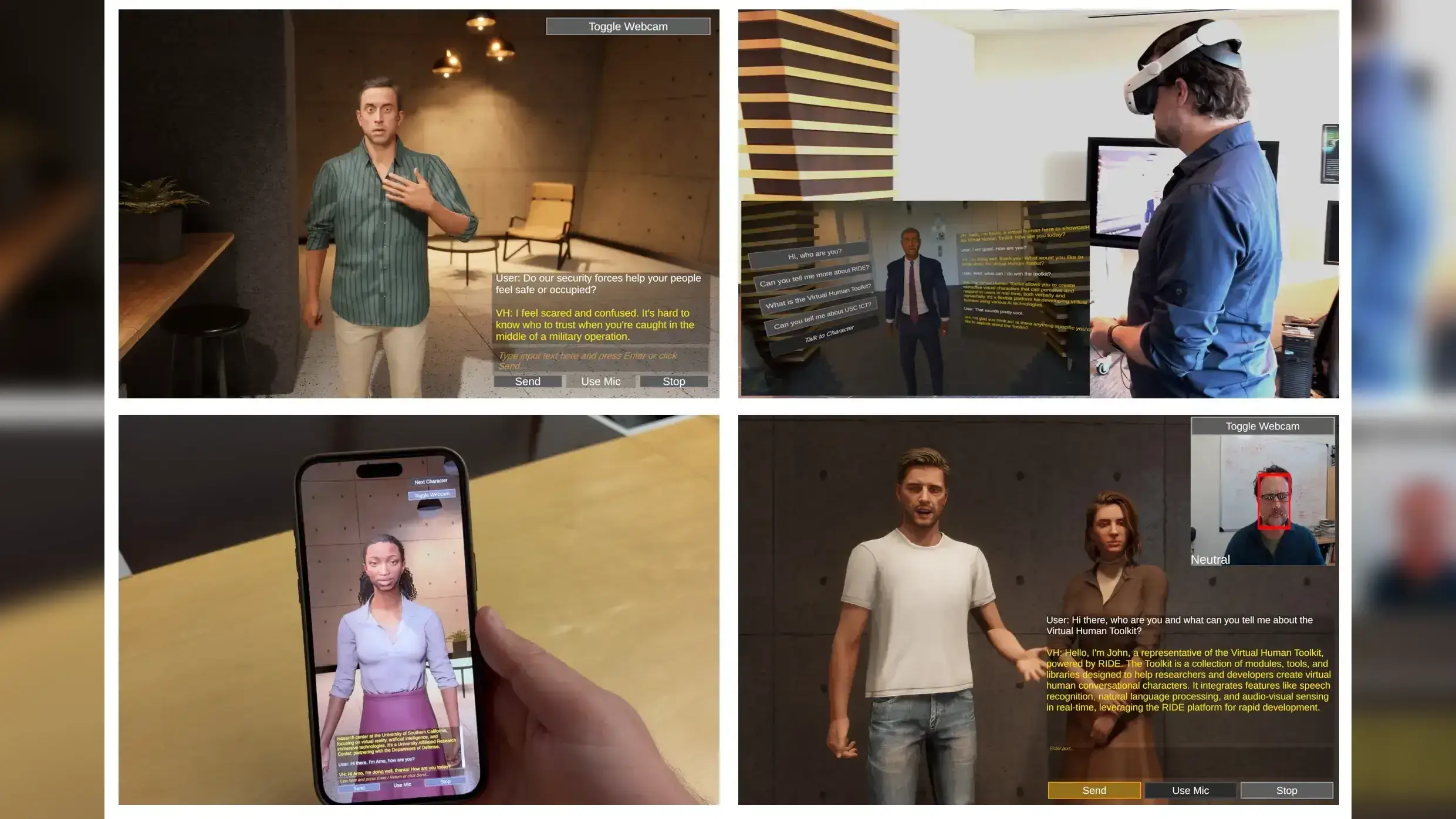
USC ICT’s platform for building conversational virtual humans is now available on GitHub, running on the web, on iPhone and Android, and on Quest 3.
The Virtual Human Toolkit (VHToolkit) is now available at https://github.com/USC-ICT/vhtoolkit
The VHToolkit is a platform for building embodied conversational agents: real-time interactive characters that perceive people and respond both verbally and nonverbally. It integrates audio-visual sensing, speech recognition, natural language processing, text-to-speech synthesis, and nonverbal behavior generation, so that researchers, educators and developers can work with a virtual human without assembling that stack themselves.
Characters are authored in Reallusion Character Creator and deploy to the web, iPhone, Android, and Quest 3. A live demo runs in the browser with nothing to install, and free apps are available for both mobile platforms.
The VHToolkit is vendor agnostic. It supports 20+ cloud and local AI service providers, including ChatGPT, Claude, ElevenLabs, Ollama and OpenFace. Each are implemented through a common API, enabling real-time switching. Running the pipeline entirely on local hardware is supported, which allows studies in which participant data never leaves the researcher’s own machines. Retrieval-augmented generation lets a character draw on custom knowledge supplied as plain text.
Also in progress is VHToolkit Studio, a no-code authoring tool for building virtual human studies that run in a web browser. It covers study conditions, custom character backgrounds and an embedded Qualtrics questionnaire, so a study can be authored and fielded without writing code. An overview is available in the project video, and registration is open for notification when accounts become available.
Both the VHToolkit and Studio will be demonstrated this week at the ACM International Conference on Intelligent Virtual Agents (IVA) 2026. The accompanying demo paper, “Demonstrating the Open Virtual Human Toolkit: Any Character, Any Technology, Anywhere,” is by Hartholt, Fast, Leeds and Mozgai.
The VHToolkit is built on RIDE, ICT’s rapid prototyping middleware, which provides the underlying architecture and service integrations. It is available under the USC-RL v3.0 license for non-commercial research and educational use.
- GitHub: https://github.com/USC-ICT/vhtoolkit
- Documentation: https://github.com/USC-ICT/vhtoolkit/wiki
- Discussion: https://github.com/USC-ICT/vhtoolkit/discussions
- Web Demo: https://vhtoolkitwww.ict.usc.edu/demo/
- iPhone: https://apps.apple.com/app/vhtoolkit-mobile/id6737787323
- Android: https://play.google.com/store/apps/details?id=edu.usc.ict.ridevh
- Studio Signup: https://vhtoolkitwww.ict.usc.edu/Studio/signup.html
- Video: https://www.youtube.com/watch?v=QU_ItB4p_zc
- IVA 2026: https://iva.acm.org/2026