

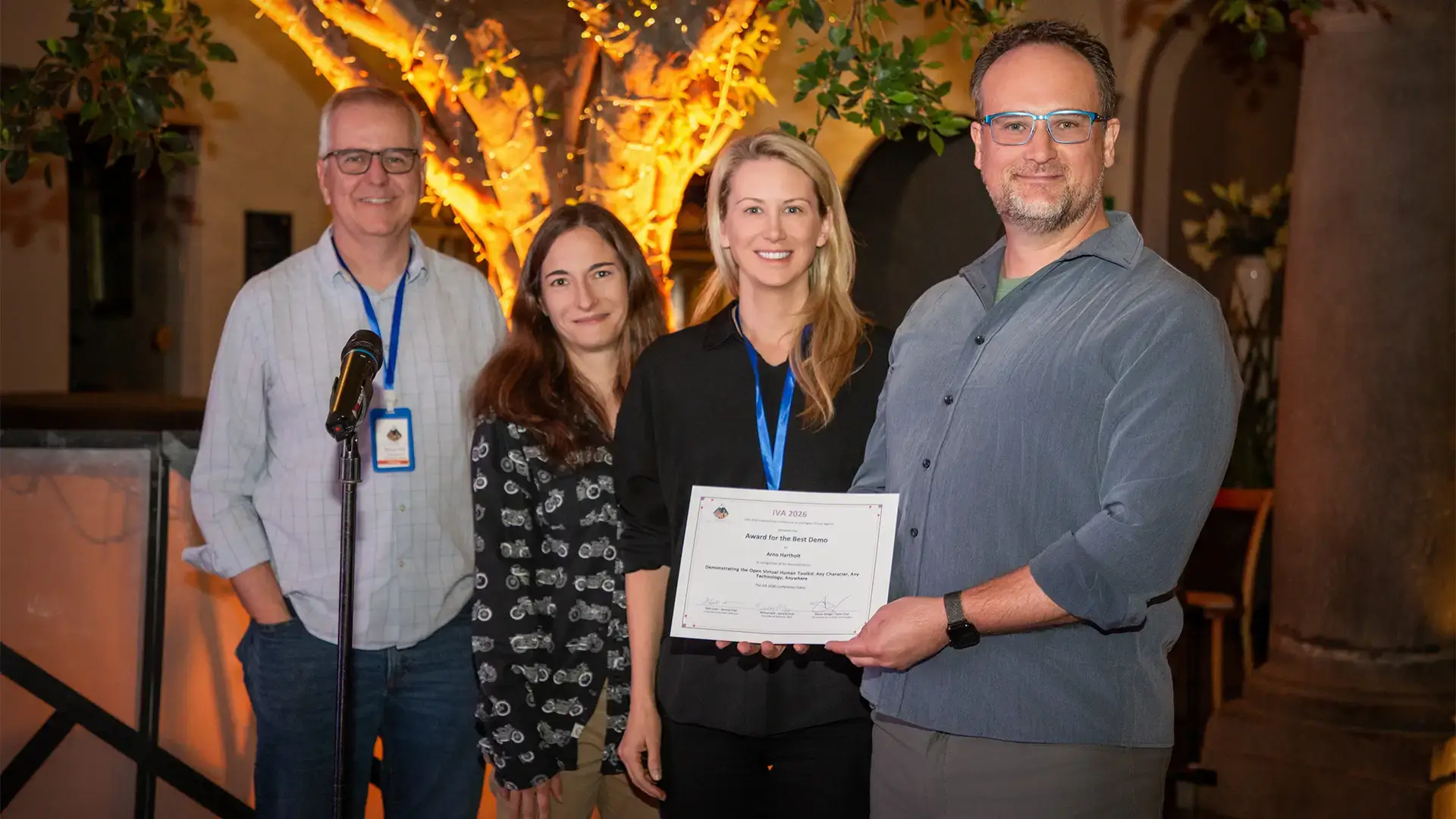
USC ICT’s open platform for building conversational virtual humans was recognized at the ACM International Conference on Intelligent Virtual Agents, the field’s primary venue.
The Virtual Human Toolkit (VHToolkit) team at USC ICT received the Best Technical Demonstration award at the 26th ACM International Conference on Intelligent Virtual Agents (IVA 2026) in Puebla, Mexico. The award recognized the live demonstration and accompanying paper “Demonstrating the Open Virtual Human Toolkit: Any Character, Any Technology, Anywhere,” by Arno Hartholt, Ed Fast, Andrew Leeds and Sharon Mozgai of ICT’s Simulations, Architectures & Intelligent Agents (SAIA) Lab and Virtual Human Therapeutics Lab (VHTL).
The VHToolkit is an open platform developed at USC ICT that allows researchers, educators, and developers to create intelligent, conversational virtual humans without having to build or integrate complex AI systems from scratch. At IVA 2026, the team demonstrated how the same virtual characters could interact with users across desktop computers, web browsers, iOS and Android smartphones, and Meta Quest 3 headsets, all using a single underlying platform. Attendees spoke to characters on mobile, web, and AR (augmented reality), discussing virtual humans in general and the VHToolkit in particular, often in their native tongue. The VHToolkit is vendor agnostic, integrating more than 20 cloud-based and local AI services, including familiar tools such as ChatGPT, Claude, ElevenLabs, and Ollama. Developers can switch between services in real time, customize characters using tools such as Reallusion’s Character Creator, or run the entire system locally when privacy or data security is a priority.
The team also previewed VHToolkit Studio, a no-code authoring tool for building virtual human studies that run in a web browser, with study conditions, custom character backgrounds and an embedded Qualtrics questionnaire. Studies can use 3D virtual humans that run directly in the participant’s browser, or optional photoreal AI-generated characters streamed as interactive live video, including characters created from an uploaded photo of a real person (with their permission).

A conference participant talks to a virtual human in the Quest 3 headset, speaking in both English and Spanish. Insert: participant view of the virtual human in augmented reality, with conversation history. Photo: Arno Hartholt.
“AI capabilities are advancing rapidly, but bringing those technologies together into an interactive virtual human remains a significant technical challenge,” said Arno Hartholt, Director of Research and Development Integration at ICT, who leads the SAIA Lab and the VHToolkit. “What we’ve focused on with the VHToolkit is giving researchers the flexibility to choose the technologies that best suit their needs, create their own characters, and deploy them across multiple platforms without rebuilding the system each time. Just as importantly, researchers have access to the source code and can run the entire system locally when privacy or data security is a concern. With VHToolkit Studio, we’re taking that a step further by making it easier to design, build, and conduct virtual human studies without requiring extensive programming expertise.”
New in this release: a unified conversation mode that handles speech recognition, language processing and speech synthesis in one continuous audio stream (OpenAI Realtime); multilingual conversations with automatic language detection; just-in-time nonverbal behavior generation for other languages; retrieval-augmented generation (RAG), so characters can answer from a researcher’s own documents; and protection against prompt injection.
The VHToolkit is available on GitHub and is built on RIDE, ICT’s rapid prototyping middleware. It is available under the USC-RL v3.0 license for non-commercial research and educational use.
Links:
Overview video: https://www.youtube.com/watch?v=QU_ItB4p_zc
Source code: https://github.com/USC-ICT/vhtoolkit
Web demo: https://vhtoolkitwww.ict.usc.edu/demo
iPhone app: https://apps.apple.com/app/vhtoolkit-mobile/id6737787323
Android app: https://play.google.com/store/apps/details?id=edu.usc.ict.ridevh
Studio signup: https://vhtoolkitwww.ict.usc.edu/Studio/signup.html